Research Interests

Industrial organization, labor economics, franchising, broadband

Working Papers
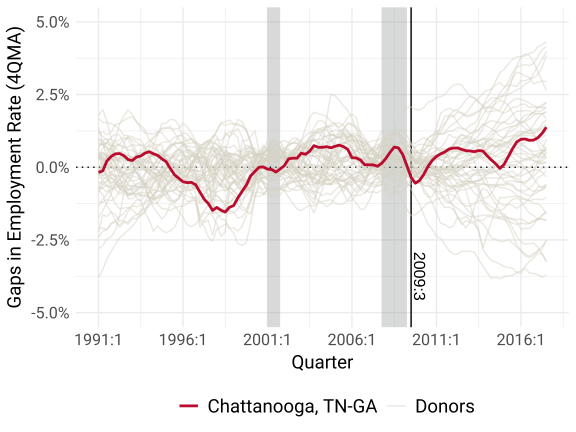
Employment Rate Differences in Chattanooga and Donor Cities

The Effect of Municipal Broadband on Labor Markets: Evidence from Chattanooga, TN

March 26, 2026
This paper studies the causal effect of municipal broadband provision on local labor market outcomes using the introduction of a publicly owned fiber-to-the-home broadband network in Chattanooga, Tennessee. Municipal broadband networks are frequently justified as tools for economic development, yet credible evidence on their labor market impacts remains limited. I evaluate this policy using a synthetic control design that constructs a counterfactual Chattanooga from a weighted combination of comparable metropolitan statistical areas in the Southern United States that were not exposed to municipal broadband projects or public-private partnerships. The analysis focuses on the employment rate measured using the Quarterly Census of Employment and Wages (QCEW), covering the period 1991-2017. While Chattanooga’s employment rate increased following the rollout of residential broadband service in 2009, placebo tests and permutation-based inference indicate that these gains are not statistically distinguishable from post-Great Recession employment growth observed in comparable cities. Overall, the results provide no evidence that Chattanooga’s municipal broadband network had a significant effect on aggregate local employment. These findings contribute to the literature on broadband policy and economic development and offer cautionary guidance for policymakers considering large public investments in government-owned broadband infrastructure.

Works in Progress

Competing Fast Food Restaurants (generated by ChatGPT)

The Labor Market Effects of No-Poach Clauses in the Quick-Service Restaurant Industry
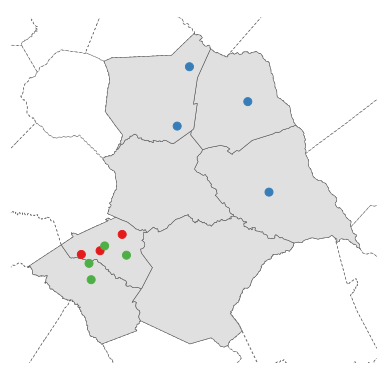
A map showing the ownership patterns of McDonald's establishments in the Athens, GA commuting zone

Multi-Unit Ownership in U.S. Fast Food Franchising

with Peter Newberry

Refereed Journal Articles

Broadband Speeds in Fibered US Markets: An Empirical Analysis

2021 Journal of Information Policy

with James Bailey (previously circulated by The Center for Growth and Opportunity)

Broadband deployment policies have directly subsidized fiber providers because fiber broadband delivers fast download speeds. This article examines whether recent fiber buildout has increased competition for Asymmetric Digital Subscriber Lines (aDSL) and cable incumbents and whether entry by a fiber competitor predicts faster incumbent download speeds. Despite significant growth in fiber broadband service in the United States between 2014 and 2019, the number of fiber competitors in census blocks with aDSL or cable incumbents remains low. Further, our econometric results, while not interpretable as causal relationships, suggest that the entry of a rival fiber operator does not explain recent increases in cable and aDSL speeds.

The Benefits of Coronavirus Suppression: A Cost-Benefit Analysis of the Response to the First Wave of COVID-19 in the United States

2020 PLOS ONE

with James Broughel (previously circulated by the Mercatus Center)

This paper estimates the benefits and costs of state suppression policies to “bend the curve” during the initial outbreak of COVID-19 in the United States. We employ an approach that values benefits and costs in terms of additions or subtractions to total production. Relative to a baseline in which only the infected and at-risk populations mitigate the spread of coronavirus, we estimate that total benefits of suppression policies to economic output are between $632.5 billion and $765.0 billion from early March 2020 to August 1, 2020. Relative to private mitigation, output lost due to suppression policies is estimated to be between $214.2 billion and $331.5 billion. The cost estimate is based on the duration of nonessential business closures and stay-at-home orders, which were enforced between 42 and 65 days. Our results indicate that the net benefits of suppression policies to slow the spread of COVID-19 are positive and may be substantial. We discuss uncertainty surrounding several parameters and employ alternative methods for valuing mortality benefits, which also suggest that suppression measures had positive net benefits.

Resting Papers

“The FCC’s High-Cost Programs, Rural Broadband Penetration & Rural Broadband Service Quality” with Brent Skorup (Draft available at SSRN)

Other Published Work
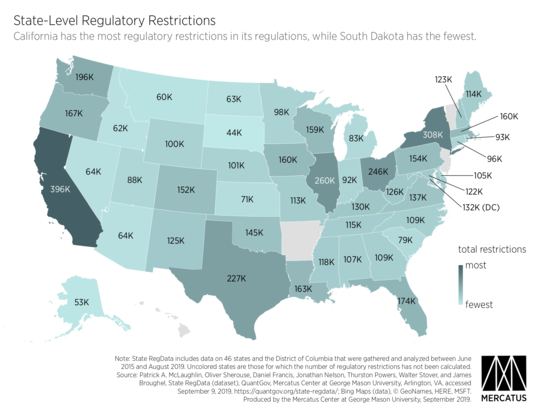
Quantifying Regulation in U.S. States

Nov 13, 2019 Mercatus Center

Regulatory restriction counts for the administrative codes of the U.S. states (with James Broughel and Patrick McLaughlin)

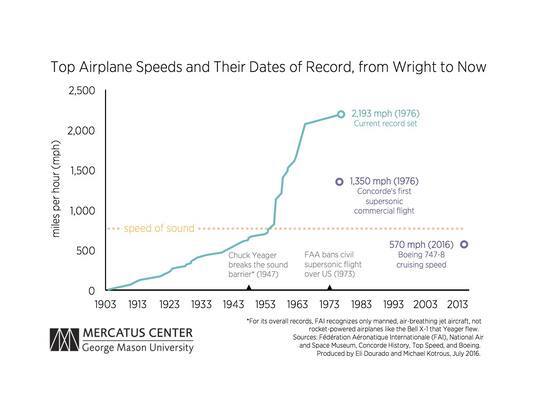
Airplane Speeds Have Stagnated for 40 Years

Jul 16, 2016 Mercatus Center

Since 1976, aviation speeds stagnated, and even regressed (with Eli Dourado)

“Narrowing the Rural Digital Divide with Consumer Vouchers” with Brent Skorup, Mercatus Center Policy Brief, October 2020

“Regulation and Net Neutrality,” Institute for Economic Inquiry at Creighton University, March 2015